Images coming soon


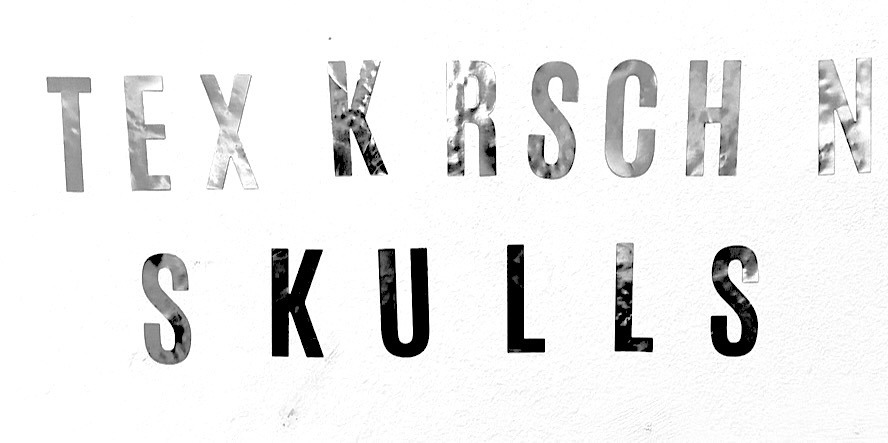
Tex Kerschen, Skulls: works list (lto r)
We’re Gonna Have A Real Good Time Together, 2026, polyester flag, o-rings, braided plastic, twine
Skulls, 2026, acrylic and paper collage
Hit the Lights, 2026, asphalt coated denim, work bucket, white stool, asphalt coated asphalt
Black Mask, 2026, duct tape and cardboard
Black Mask, 2026, duct tape and cardboard
Black Mask, 2026, duct tape and cardboard
Black Mask, 2026, duct tape and cardboard
Black Mask, 2026, duct tape and cardboard
Black Mask, 2026, duct tape and cardboard
Black Mask, 2026, duct tape and cardboard
Beyond Good and Evil, 2026, asphalt coated copy of Friedrich Nietzsche’s Beyond Good and Evil, porcelain stand
We Just Wanna Cruise, 2026, 15 minutes sound collage with dubbing errors, cassette, cassette player, portable speaker
Use Your Illusion 3, 2026, doormat with quote from Albert Camus, The Rebel
““Who are they? Why are they running? Can they be coming at me? And why? To kill me? Me whom everyone is so fond of?” He remembered his mother’s love for him, and his family’s, and his friends’, and the enemy’s intention to kill him seemed impossible.” Leo Tolstoy, War and Peace
Top 10 (Oct 2026)
• Rereading Nanni Balestrini’s We Want Everything, a novel about the Autonomia workers movement (recommended in an essay by Rachel Kushner) told by a Southern Italian worker raising hell in a northern Italian factory.
• Evicshen at Nameless Sound weekend… inventive and committed, like a one-person Marx brothers of noise. I had been missing the intimations of danger in art (not in life, to be clear). Beyond that, her sense of the possibility of sound-emitting props is on another level.
• Maria Chavez’ workshop at UH in which she invited the audience to break records into shards and make a dizzy racket on her turntables following her apocryphal accounts of the history of recorded sound, or, at least, record players.
• Chris Cascio “Culture Club” at Basket Books, not just the best dirty boy maximalism I’ve seen in a long time, my favorite exhibition of the year
• Lucia Berlin, A Manual For Cleaning Women, the most readable chronicle of alcoholism, cancer, and entropy I’ve come across yet.
• Hi I’m Pretty, aka the Wednesday nighters, my daughter’s rock band with 2 of her friends whose songs are so much better than they ought to be.
• Fabiola Torres-Alzaga, “Day For Night,” a compelling staging of Hitchcock inspired dolly-mounted atmosphere and impeccable production design I had the good fortune to see in her studio in Mexico City.
• The Keith Haring bathroom in New York. I never really got his work before seeing this. Now I think I get it and I know I like it.
Excerpt from an interview with TK by Gross Gerald, Bon Temps
Gross Gerald: Where did the title of this show, “Skulls,” come from? Morbidity?
TK: No. Skulls is a popular song by the Misfits. While I have had many reasons to think about death, this show is not about death. It’s the aftermath of a fixation with getting to the roots of this business, an attempt to X out distractions like the use of color and language and conceptual discernment and anything else obstructing my view of a possible original impetus for this ongoing decision to do things the hard way, perform synchronized swimming routines in a lap pool of failure, fritter away my short time in paradise.
Gross Gerald: And did you find any source or impetus in this removal process you are describing?
TK: I went back to adolescence and found most of the same habits there. I was an uneven kid, a dirtbag kind of, um, nerd, and now I suspect I didn’t go back nearly far enough. Might be time to consider transgenerational epigenetic inheritance.
Gross Gerald: Uh huh. Could you talk about the asphalt covered objects? There’s a book, a jacket, a pair of glasses; are they saying something about the way we treat the environment?
TK: No. Although my dad was an oil field worker, a roughneck, then a driller and an operations guy later and he… later, he moved over to the safety side, he has for a long time given voice to his serious concerns about the ruin of our environment, the exploitation of labor, and the corrupting influence of money in politics, I am a simpler case.
Art is child’s play to my way of thinking, and these are acts of literalizing the imaginative. Jean Cocteau said a true gardener doesn’t perfume the roses. Nevertheless, here I go, day after day, month after month, um, coating the asphalt in asphalt.
Gross Gerald: Ok. Something that I noticed in your music presentations over the years is that you tend to lean into being anonymous. You literally play in the dark and you use pseudonyms and sunglasses to obscure yourself. Do the mask-like objects in this show have something to do with that?
TK: I hadn’t made that connection until you said it. It’s a possibility. The black masks in my show are reproductions of the balaclavas worn by different members of the IRA. I sourced them from photographs available on the internet, of which there are surprisingly few. They also refer to the work of New York visual artist Ben Morea.
Gross Gerald: And why reference the IRA at all?
TK: indecipherable… living in England during the troubles and my mother played IRA, Irish Republican Army records. I don’t know why, in retrospect. My mother was proud of her Irish roots, and she claimed to be 100% Irish, though DNA tests and homespun genealogy reports throw some shade on that. Either way, the combination of IRA music and the outsider feeling that I experienced growing up in a foreign country contributed to the alignment of my sensibilities regarding the wellbeing of myself and others. I have always been a soft boy, a quietist, but I get anxious and upset when I encounter the evidence of injustice and oppression in this world and in this country in particular, you know, like these ICE raids, or the way we’re gaslighting the people of Venezuela and Iran at the moment.
Gross Gerald: Walter Pater once declared: “All art constantly aspires towards the condition of music.” Do you think about these works in a different way from how you think about your music recordings and performances?
TK: Hmm. I know that I usually listen to music when I’m making visual art, but I can’t listen to other people’s music when I’m working on my own.
Gross Gerald: You worked with the late museum director Jim Harithas. What influence did that have on your work? Are there any other people who have particularly influenced you or that you find inspirational?
TK: Yes. I said it when he was alive and I’ll continue. Anything I can’t credit to transgenerational epigenetic inheritance I freely credit to him. Harithas was brave and intellectually curious and outraged by the suffering of others. I was with him in Gaza when he was in his seventies visiting people in refugee camps and smuggling art through military checkpoints. Long before that, at the time I was first getting into the Dead Kennedys, he was driving medical supplies down to Central America to help people displaced by civil wars. I have tried to copy these traits as part of my regimen of self-help and personal growth, but, you know, baby steps…